Monday, November 18, 2013

Blog #3

Blog Deliverable #3

1. Triangle Insert Parameter Process Sheet

The parameters for the triangle insert were improved through the trial and error of runs. We started with values close to what we deemed were plausible to produce a quality part. With each run, certain parameters were changed in order to create a better product. We came away with values of 8 seconds and 20 seconds for the holding time and cooling time, respectively. The screw feed stroke was set to 2 inches while the screw feed delay time was 0 seconds or not necessary. The injection speed profile from V12-V21 ranged from .2 to 3.5 with an injection pressure of 1101 PSI. The injection pressure was chosen in order to ensure full packing of the mold and to make sure no vacuum voids would form during the cooling period. The injection pressure also allows for the mold to be completely filled with plastic while not allowing flash along the outer edges of the part. The ejector counter was set at 2 and the ejector pin lengths were 5.647 and eight of them were used.

The parameter process sheet for the triangle insert:


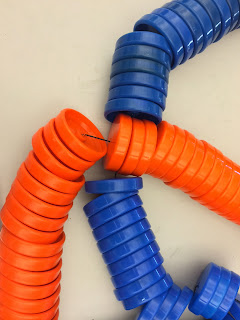
Below is a stack of optimized triangle inserts.


2. Process Optimization

 The process optimization labs allowed the Aperture Science team to work on fixing molds and production processes in order to produce a quality Yo-Yo. Through this work, several part and mold redesigns were found to be necessary to improve our product. We had to remachine the triangle spider because a defect was created in the mold from where a tool broke while machining the mold. However, no dimensions were changed from the previous mold. The triangle insert involved the most rework. A new cavity mold was machined for the triangle insert. The triangles were made higher and larger so the part would cool better and more uniformly. This also helped with reducing the void in the corners of the triangles on the underside. A ten degree draft angle was added to the triangle as well. This made the part easier to remove from the mold, reducing its chance to stick to the mold. The inside of the triangle mold was sanded as well, in order to eliminate machine lines. The string gap was also changed. Our original specification for the string gap was set at .25 inches. This was a rough estimate without any reference. When it came time to machine shafts for the body of the yo-yos, we realized this initial guess was far off from an acceptable dimension especially since our mold thickness was .25 inches. Our string gap was reduced to .075 inches. Much like the numbers for the triangle insert, the other parts were run and our group selected appropriate values for the speeds and pressures in order to create the best part we could. Through our groups testing, we came away with a completed optimized working yo-yo which spins around 3350 RPM.


Here is a picture of the new triangle insert mold:

Below are pictures of various parts of the Yo-Yo (body, triangle inserts, triangle spider):


Here is a picture of Kyle working hard optimizing the body of the Aperture Science Yo-Yo:


Below is a video of Ben playing with a completed Aperture Science Yo-Yo.


Below are the process parameter sheets for each part of the Aperture Science Yo-Yo. These include both thermoforming and injection molding parts. The triangle insert is located up above in part 1 of the deliverable.


Sunday, October 20, 2013

Blog Deliverable 2

 Injected Molded Part Presentation


These are the core (left half) and cavity (right half) mold of our ‘triangle insert’ piece. This piece is going to be snap fit into the main body and will make up the main triangle shape of the Aperture Science logo. The large triangles in the core mold on the left will be the triangles in the logo while the small triangles on the cavity mold on the right are meant to thin the part so that it cools more evenly. The small indents around the outside of the cavity mold are to make runners for our ejector pins to push off of.
To calculate our mold dimensions our first reference was the inner diameter of the body piece. We needed to make sure this would be able to snap fit in so we sized this piece’s outer diameter to be 0.01” larger than the inner diameter of the body. Then we had to scale the mold to allow for shrinkage. We measured the size of dimensions on a mold from a past year for a part of similar volume and thickness. We found a part with a mold diameter of 2.4” and an average part diameter of around 2.36. After measuring a few other dimensions on the mold and on the injection molded parts we determined that the parts shrank by about 1.5%. We scaled our mold up by this amount accordingly before creating the tool paths in Mastercam.
All of the work for this mold was done on the mill. The core took about 1 hour and 20 minutes to machine including tool switching time and the cavity took around 45 minutes. The longest process on the core mold was machining the triangle holes. Each has a 1/16” radius in each corner which was first drilled with a 1/16” end mill, then the pocket was machined with a 1/8” end mill and remachined with the 1/16” end mill to clean up anything that had been left.

Manufacturing Time


The machining time require to produce our yo-yos includes the manufacturing time for the molds, each injection molded and thermoforming piece in the final production run and time due to process optimization. We assumed that the time to change tools is zero in the machining process. Also, we assumed that the process optimization for thermoforming parts is less than that of injection molding parts. The time to produce each mold was taken from Mastercam’s toolpath times. The spider cavity mold will take 6 minutes while the core will take 154 minutes for a total of 160 minutes or 2 hours and 40 minutes. The triangle insert cavity will take 46 minutes while the core will take 105 minutes for a total of 151 minutes or 2 hours and 31 minutes. The body cavity mold will take 4 minutes while the core will take 8 minutes for a total of 12 minutes.
               To find the cycle time for each injection molded piece, we used the typical cycle of injection molding from lecture with incorporating each pieces individual estimated cooling time. In order for a piece to be cool enough to inject, the thickest part of the piece must be at a temperature where there is no viscous rubbery flow of material and the polypropylene exhibits plastic material behavior. We used AutoDesk Simulation Mold Flow Advisor to estimate the cooling time of each part made for our yo-yo assembly. The simulation provided us with cooling times that we added into our cycle time for each piece. The body piece will take 45 seconds, the spider 16 seconds, while the triangle insert will take 40 seconds to produce one of. Multiplying these out to produce 50 yo-yos, 100 of each component will need to be produced. Assuming no time lost to change tools, the production run will take 75 minutes, 27 minutes, and 67 minutes respectively for the pieces above. For the thermoforming Portal insert, we expect a time to complete one piece in the range of 15-60 seconds. For 100 of them, the estimated time is between 25-100 minutes.
               The total time estimated to complete the yo-yos is the mold fabrication, total production run for the injection molded pieces plus the estimated time for thermoforming and the time to assemble the yo-yos.  Our total time estimated is between 11 hours 7 minutes to 12 hours 22 minutes depending on thermoforming time.


Process
Time to Manufacture
Final Production Run (time x 100) Makes 50 yo-yos
Process Optimization
 Body Mold Fabrication
12 minutes


Spider Mold Fabrication (cavity + core)
160 minutes


Triangle Insert Mold Fabrication (core + cavity)
151 minutes


Portal Insert Thermoforming Mold


Body Injection Molding
45 seconds
75 minutes
60 Minutes
Spider Injection Molding
16 seconds
27 minutes
60 Minutes
Triangle Insert Molding
40 seconds
67 Minutes
60 Minutes
Portal Insert Thermoforming

25-100 minutes
30 Minutes
Assembly
180 seconds
150 minutes
120 Minutes
Total Time (Mold manufacturing time + Final Production Run+Assembly)

642 minutes


Manufactured Molds

Triangle Insert

 Triangle Insert Mold
Triangle Insert Core Mold Being Machined

Potential rework machining for the triangle insert mold may be needed in order to get the snap fit to work correctly between pieces.

Below is a movie of the mold being machined


Body


 Body Cavity Mold, Body Core Mold, Body Molds

Potential rework machining may be needed on the body core mold in order to get the snap fit to work between pieces. The size of the core diameter may need to be smaller due to shrinking of other pieces.